Why Use a Smith Chart
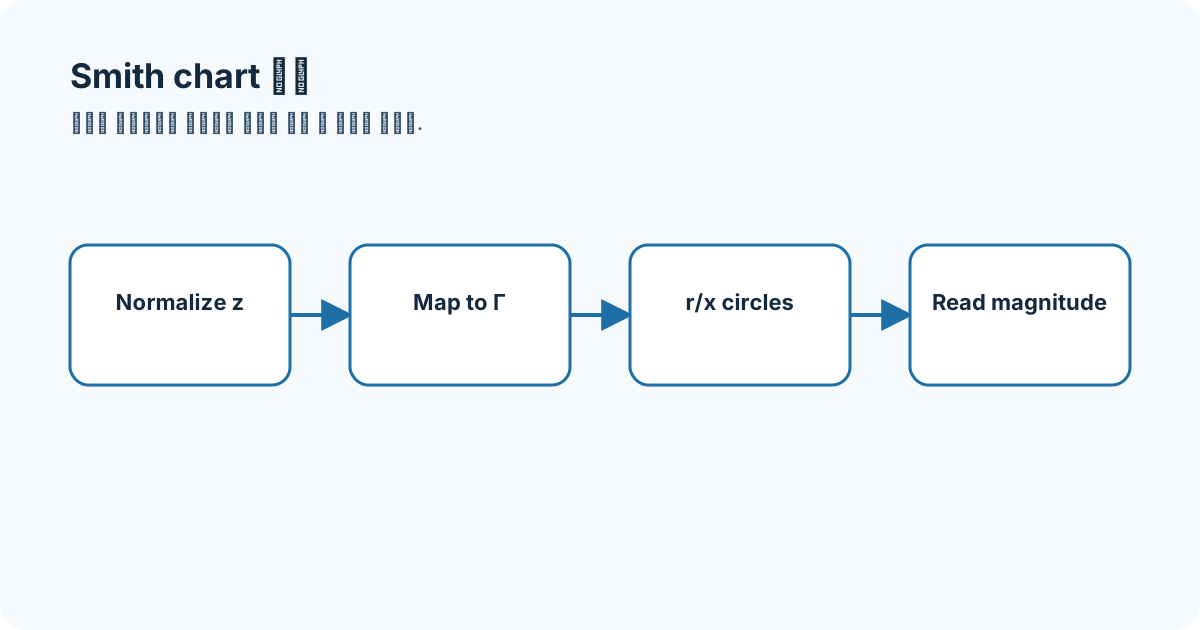
I used the RFDH Smith-chart notes to revisit mapping complex reflection and impedance on one bounded plane with a hand calculation and my own diagram.
RF · Microwave Series
Ten steps from normalization and L/C movement to admittance, line rotation, and single-stub matching.
I used the RFDH Smith-chart notes to revisit mapping complex reflection and impedance on one bounded plane with a hand calculation and my own diagram.
I used the RFDH Smith-chart notes to revisit normalizing by reference impedance and restoring ohms with a hand calculation and my own diagram.
I used the RFDH Smith-chart notes to revisit reading intersections of constant-resistance circles and reactance arcs with a hand calculation and my own diagram.
I used the RFDH Smith-chart notes to revisit reading |Γ| and phase from distance and angle with a hand calculation and my own diagram.
I used the RFDH Smith-chart notes to revisit how series reactance moves along a constant-resistance circle with a hand calculation and my own diagram.
I used the RFDH Smith-chart notes to revisit adding parallel elements as susceptance on the admittance chart with a hand calculation and my own diagram.
I used the RFDH Smith-chart notes to revisit using a 180-degree rotation to switch between z and y with a hand calculation and my own diagram.
I used the RFDH Smith-chart notes to revisit how line length rotates phase on a constant-|Γ| circle with a hand calculation and my own diagram.
I used the RFDH Smith-chart notes to revisit finding a g=1 point and cancelling susceptance with a stub with a hand calculation and my own diagram.
I used the RFDH Smith-chart notes to revisit re-reading my stored Smith trajectory by design frequency and component order with a hand calculation and my own diagram.