RF · Microwave Study
Reading 50 Ohms, Ports, and Matching as One Flow
Memorizing 50 ohms, ports, and matching separately made S-parameter setups confusing. I drew the source-line-load reference planes first and connected all three terms on one path.
- Sequence
- 2 / 32
- Track
- core
- Tools
- RF calculators
On this page
Question I started with
Memorizing 50 ohms, ports, and matching separately made S-parameter setups confusing. I drew the source-line-load reference planes first and connected all three terms on one path.
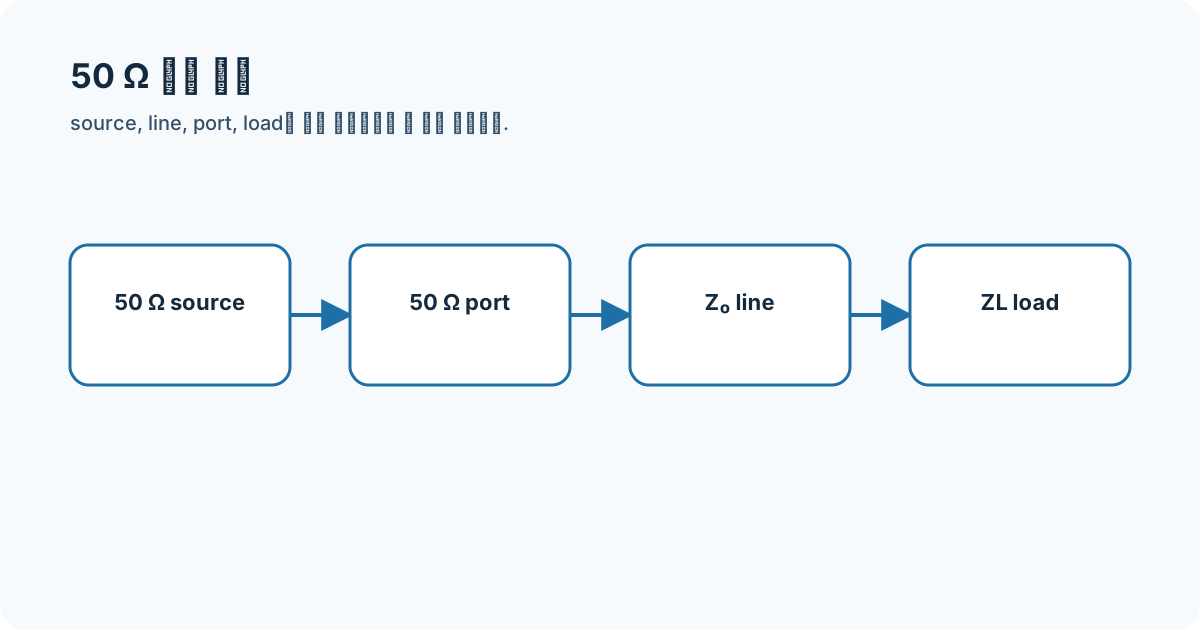
Connecting the concepts
A port is a reference plane for incident and reflected waves, not merely a wire label. ZL=Z0 gives zero reflection, while conjugate matching and transmission-line matching can serve different objectives.
- 50 ohm
- port
- reflection coefficient
- matching
Equations and assumptions
I write the reference impedance, units, and linear-versus-decibel domain before substituting numbers.
Gamma = (Z_L - Z_0) / (Z_L + Z_0)Z_t = sqrt(Z_0 Z_L)Worked example
A 100-ohm load on a 50-ohm line gives Γ=1/3 and reflected power |Γ|²=1/9, about 11.1%. A quarter-wave transformer between them uses 70.71 ohms.
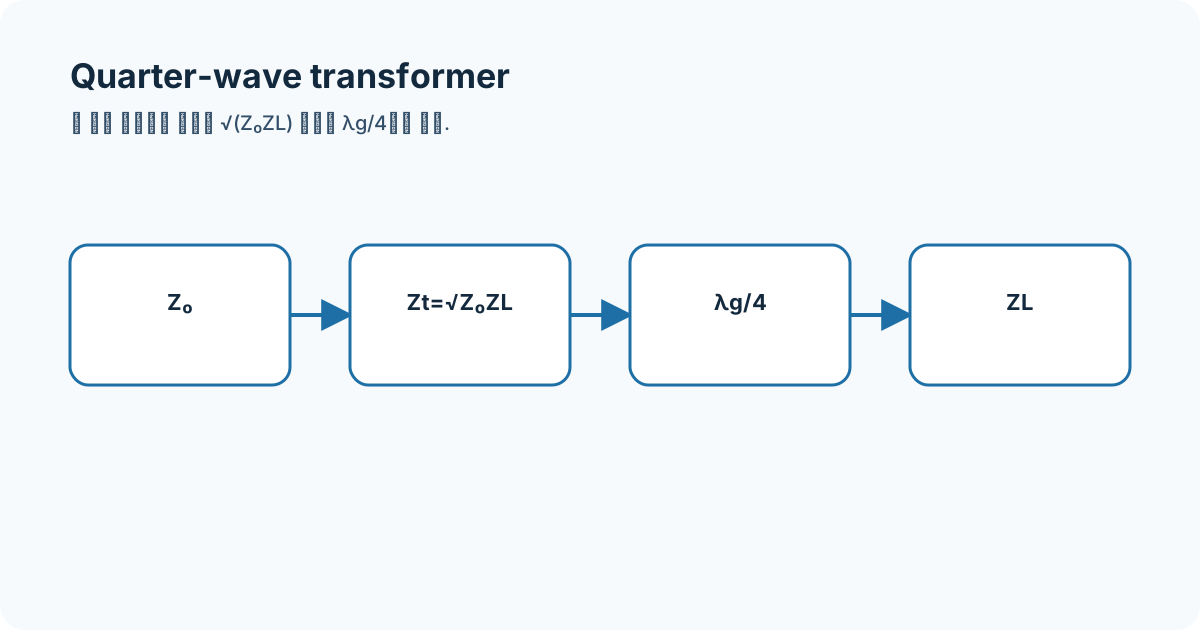
Connecting it to my coursework and projects
The 70.7-ohm branches in my Wilkinson assignment start from the same square-root relationship, but the odd-mode isolation resistor is also needed to describe the full network.
High-frequency engineering course hub
What I will check next
A 50-ohm label does not automatically prove maximum available power. Source impedance, reference impedance, load, and available power remain separate definitions.