Radar · Biomedical Signal Processing

FMCW Radar Cardiac Timing

Aligns ECG, SCG, and non-contact FMCW radar on a beat-relative axis and analyzes morphology-based AO/AC candidate timing.

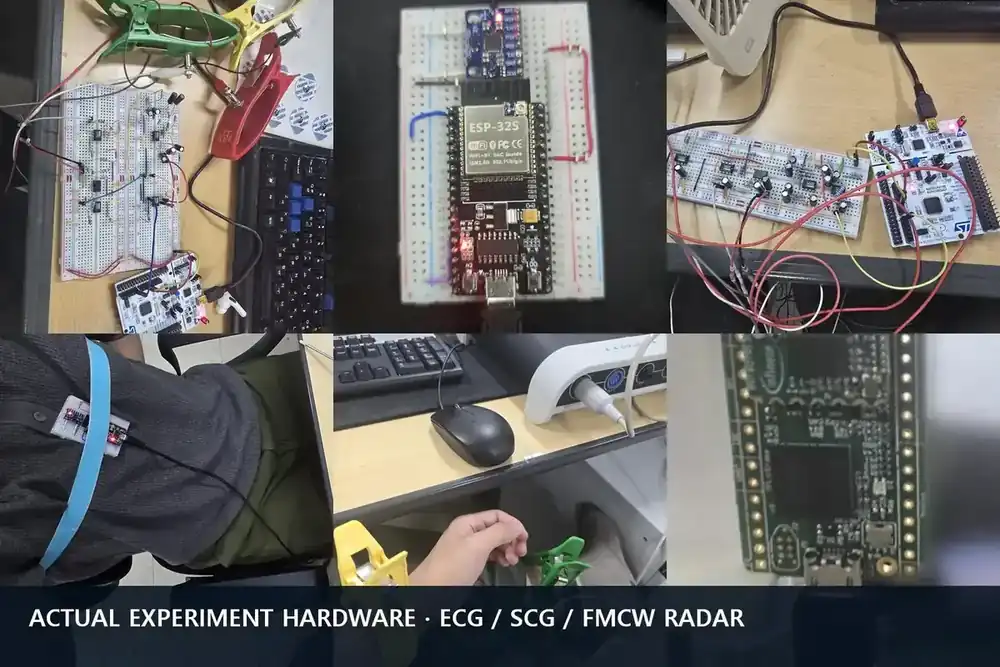
Analysis source and real hardware
ECG, SCG, and FMCW radar experimental hardware and sensor setup

01

Problem

The project analyzes AO/AC-related candidate timings in non-contact FMCW radar cardiac displacement waveforms aligned with ECG and SCG.

02

Architecture

Concurrent ECG/SCG/BGT60TR13C radar acquisition → ECG R-peak alignment → beat segmentation → phase-displacement and morphology candidate analysis → SQI/CTI export.

03

Hardware and Software

  • BGT60TR13C
  • STM32F411
  • ESP-32S
  • MPU6050
  • Python
  • NumPy
  • SciPy

04

Data Flow

Six hundred seconds of concurrent signals are aligned to a common time axis, producing 848 corresponding beats for candidate-timing distribution analysis.

05

Methodology

  • Constructed ECG R-peak anchors and SCG reference timings
  • Calculated radar phase displacement and beat-relative segments
  • Exported detector fusion, signal-quality indices, and candidate timing intervals

06

Results

  • 600 seconds of concurrent ECG, SCG, and radar acquisition
  • 848 corresponding beats analyzed
  • Radar-derived AO/AC candidate timing distributions constructed
01Problem

The project analyzes AO/AC-related candidate timings in non-contact FMCW radar cardiac displacement waveforms aligned with...

02Architecture

Concurrent ECG/SCG/BGT60TR13C radar acquisition → ECG R-peak alignment → beat segmentation → phase-displacement and morpho...

03Method

Constructed ECG R-peak anchors and SCG reference timings

04Result

600 seconds of concurrent ECG, SCG, and radar acquisition

A compact problem-to-result map generated from the project data used on this page.

What I worked on

  • ECG R-peak anchoring and SCG reference timing
  • Radar phase displacement and beat segmentation
  • Detector fusion, SQI, and CTI export

Code and results

  • Analysis source plus configuration and export documentation
  • STM32 and ESP32 acquisition firmware
  • Photographs of the hardware used for concurrent ECG, SCG, and radar acquisition

Next steps

The current AO/AC values are candidate timings derived from radar morphology. Extending this work to direct valve imaging or clinical performance requires follow-up comparison with independent echo, ICG, or PCG measurements.

I aligned SCG and FMCW radar waveforms around ECG R-peaks and compared AO and AC candidate timing. These candidates come from radar-phase morphology; they are not direct images of heart valves.

Publication first-page preview