Safely connecting computers, CRTs, cassette storage, and SCSI devices from different generations requires validating signal topology, levels, termination, and protocol rather than matching connector shapes.
02
Architecture
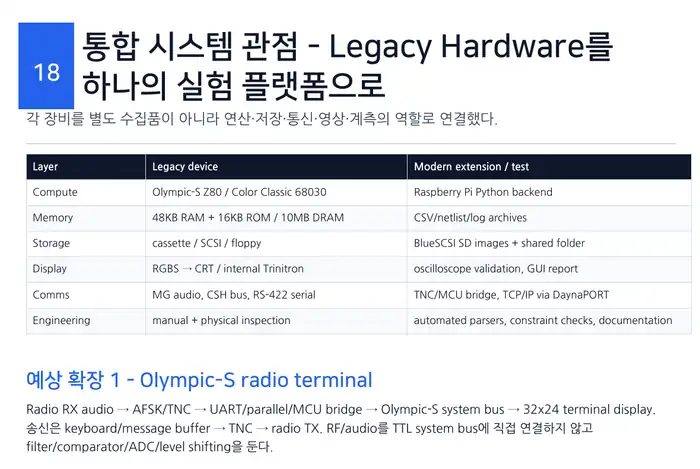
The architecture maps Olympic-S Z80, 64-KB memory, TTL/glue logic, RGBS, cassette, and 64-contact bus alongside the Color Classic 68030, 10-MB DRAM, ADB, RS-422, and SCSI, with BlueSCSI/Pico-W and a Raspberry Pi backend as the modern data and validation layer.
03
Hardware and Software
MC68030
Z80-compatible CPU
RGBS
SCSI
ADB
RS-422
BlueSCSI
Raspberry Pi
04
Data Flow
Modern PC/Raspberry Pi → SD/BlueSCSI → SCSI bus → Color Classic HMI; Olympic-S RGBS/cassette/system bus → level, termination, and continuity checks → CRT, recorder, or MCU bridge.
05
Methodology
{"Applied five evidence levels"=>"direct observation, cross-check, document-confirmed, reasoned inference, and pending measurement"}
Cross-checked PCB markings, OS screens, source manuals, and connector photographs in functional-block and interface matrices
Defined bring-up order and hazards for power, video, storage, and communication paths
06
Results
Mapped the Color Classic 68030, 10-MB DRAM, SCSI, ADB, serial architecture, and major logic-board components
Documented the Olympic-S Z80-family CPU, 48-KB RAM, 16-KB ROM, DIN-5 RGBS, and 1200-bit/s cassette path
Produced a bridge architecture that separates the legacy HMI from the modern backend and prioritizes follow-up measurements
Architecture and result views
Interface flow that validates RGBS topology, signal levels, and 75-ohm termination before connectionEvidence matrix separating photographs, functional history, source specifications, inference, and pending measurements
What I worked on
Mapped CPU, RAM, ROM, ASIC, TTL, and connector blocks on 68030- and Z80-era boards
Decomposed RGBS, DIN-5, SCSI, ADB, RS-422, and cassette interfaces into signal and electrical checks
Defined BlueSCSI, Pico-W, and Raspberry Pi data paths plus continuity, level, termination, and ripple tests
Code and results
A 23-page technical portfolio with hardware, PCB, and runtime photographs
Color Classic 10,240K boot screen and logic-board chip markings
Olympic-S manual specifications for 48-KB RAM, 16-KB ROM, 1200-bit/s cassette data, and DIN-5 RGBS
Design scope and next steps
Sources: hardware, PCB markings, OS screens, and original manuals. Follow-up tests: RGBS levels, termination, cable continuity, cassette SAVE/LOAD, and DaynaPORT TCP.
Color Classic and Olympic-S records map CPU, memory, storage, video, and communication layers. PCB markings, OS screens, and source manuals support the functional-block and interface tables.
The BlueSCSI/Raspberry Pi material covers a bridge data-path design and RGBS, SCSI, cassette, and TCP measurement plans.