Electrical Engineering Coursework · Embedded Systems
From 68030 and Z80 Hardware to a Legacy-Modern Bridge
2026-09-08 · updated 2026-09-08 · Hyeongrok Ryu
Architecture and interface analysis of the Macintosh Color Classic and Olympic-S across compute, memory, buses, RGBS, cassette data, and SCSI, with explicit measurement boundaries.
- Type / level
- project-log · advanced
- Tools
- MC68030, Z80, RGBS, SCSI, BlueSCSI, Raspberry Pi
From collection to experiment platform
I treated the hardware as an experiment platform for comparing embedded-system architectures and signals, not simply as vintage equipment that still powers on. The Macintosh Color Classic is a 68030-based 32-bit system. The Olympic-S exposes its Z80-family CPU, RAM, ROM, and TTL/glue logic across an 8-bit board. Their storage, video, and communication paths also assume different voltage, timing, and termination conditions.
The useful question was not “which cable fits?” but “which signal crosses the boundary, relative to which reference and electrical level, and what must be measured before connection?” I therefore cross-checked PCB markings, OS screens, source manuals, and functional history while recording the strength of each piece of evidence.
Reading 68030 and Z80 boards
On the Color Classic, I separated the MC68030FE16B, onboard DRAM and 30-pin SIMMs, VRAM module, Apple/VLSI custom ASICs, Zilog SCC-family serial controller, and accelerator board into functional blocks. A System 7.5.1 screen directly shows 10,240K of memory. A VRAM module is visible, but I do not claim a 512-KB total without a diagnostic capture.
On the Olympic-S, I mapped the Z80-compatible CPU, 48-KB RAM, 16-KB ROM, large DIP TTL area, speaker, and 64-contact connector. Address decoding, display timing, multiplexing, and glue logic that would sit inside a modern MCU or SoC remain physically distributed, making the address, data, and control buses accessible to a logic analyzer.
RGBS cassette and SCSI
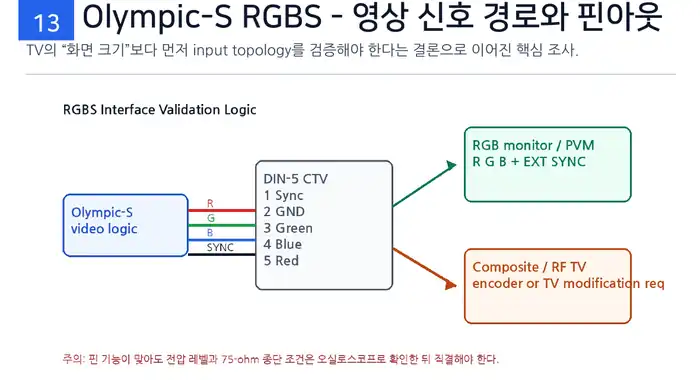
The Olympic-S source manual identifies the CTV DIN-5 pins as Sync, Ground, Green, Blue, and Red. A television with only composite or RF input is therefore not a direct match. Even when a monitor accepts RGB plus external sync, amplitude, polarity, common reference, and 75-ohm termination must be measured before the connection is made.
The 1200-bit/s cassette path converts digital data into an audio-frequency waveform for magnetic recording, then restores pulses through an analog front end and comparator during playback. With the National RQ-8050, LOAD runs from recorder CMT OUT to the computer tape input; SAVE runs from the computer tape output to recorder CMT IN. The direction is documented, but the round-trip test remains pending.
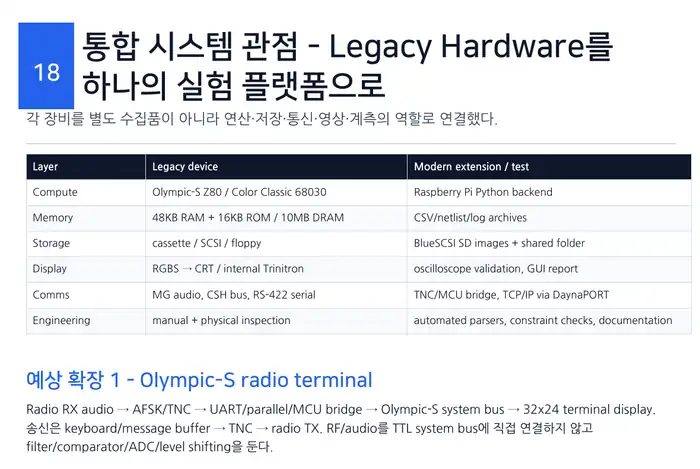
The Color Classic SCSI path can use BlueSCSI for SD-card disk images and a
/shared file path. I classified ADB as the keyboard/mouse HMI and RS-422 serial
as a candidate instrumentation or bridge interface. These ports are not one
generic I/O group: they serve storage, HMI, and serial-measurement boundaries.
Legacy-modern bridge
The first designed path moves files from a modern PC or Raspberry Pi through SD and BlueSCSI onto the SCSI bus, with the Color Classic acting as the display HMI.
Modern PC / Raspberry Pi → SD / BlueSCSI → SCSI bus → Color Classic GUI
The second path uses a Classic Mac UI to enter power-rail, BOM, or trace-length constraints. A Raspberry Pi Python backend checks KiCad CSV/netlist exports and returns PASS/WARN/ERROR. Modern EDA still performs BGA fanout, differential routing, and DRC; the Mac handles input, test execution, and report viewing. Separating the compute backend from the legacy HMI gives the older machine a precise role without overstating its capability.
Evidence levels and test plan
I used five evidence levels: A for direct hardware, screen, or PCB observation; B for repeated use or cross-device functional checks; C for source manuals or manufacturer specifications; D for reasoned inference from photographs and architecture; and E for pending oscilloscope, multimeter, or continuity work.
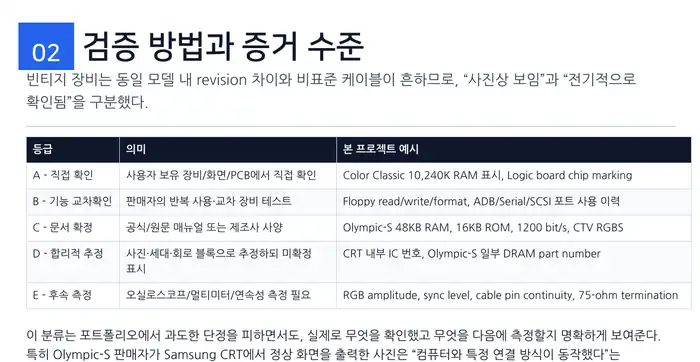
A seller photograph of a working CRT display supports the statement that a particular connection operated, but it does not reveal the exact cable pinout or signal levels. The 10,240K Color Classic screen, by contrast, is direct visual evidence and can be reported as such.
Transferable engineering competencies
The transferable value is not nostalgia or memorizing obsolete parts. It is the ability to divide a board into compute, memory, glue logic, and connector blocks; translate manual specifications into physical-interface requirements; and turn uncertainty into continuity, level, polarity, termination, and ripple tests.
That process applies to embedded hardware bring-up, vehicle HMI or gateway validation, defense-system legacy interfaces, production I/O checks, and early quality work that must distinguish confirmed, inferred, and unverified behavior. This project does not claim automotive or defense qualification; it demonstrates requirements definition and evidence-based test planning across incompatible power, communication, storage, and display subsystems.
Completed scope and next measurements
Completed work includes the Color Classic boot and memory display, major chip mapping, Olympic-S manual-to-PCB architecture mapping, RGBS pin functions, cassette I/O direction, and the BlueSCSI bridge design. The next four steps are:
- Map CTV cable continuity and measure R/G/B/Sync amplitude, polarity, and impedance.
- Run an RQ-8050 SAVE/LOAD round-trip with a known-good cassette.
- Test a Color Classic → BlueSCSI/Pico-W → Raspberry Pi TCP echo path.
- Display a KiCad CSV checker result in a minimal Classic Mac GUI.
Until those tests are complete, I do not describe RGBS electrical compatibility, cassette reproduction, DaynaPORT connectivity, or the engineering frontend as finished results. Keeping analysis, implementation, and measurement evidence separate is the central documentation rule of the project.
Sources used
- Legacy Embedded System Architecture and Mixed-Signal Interface Research — source-portfolio; architecture interface evidence and test boundaries
- Macintosh Color Classic Technical Specifications — vendor-documentation; processor memory video and interface specifications
- BlueSCSI Toolbox and Wi-Fi DaynaPORT — project-documentation; shared-folder and SCSI bridge architecture
- Olympic-S operation manual scan — source-manual; memory cassette RGBS and expansion-interface specifications