AI · Deep Learning · Computer Vision · Transformer
OUTTA Basic — Organizing BERT, Hugging Face, and Gemini Safely
2026-08-01 · updated 2026-08-01 · Hyeongrok Ryu
I focused on tokenization, attention masks, BERT output shapes, and environment-based credential handling for Gemini.
- Type / level
- study-note · intermediate
- Tools
- Python, PyTorch, Transformers
Three parts of a BERT input
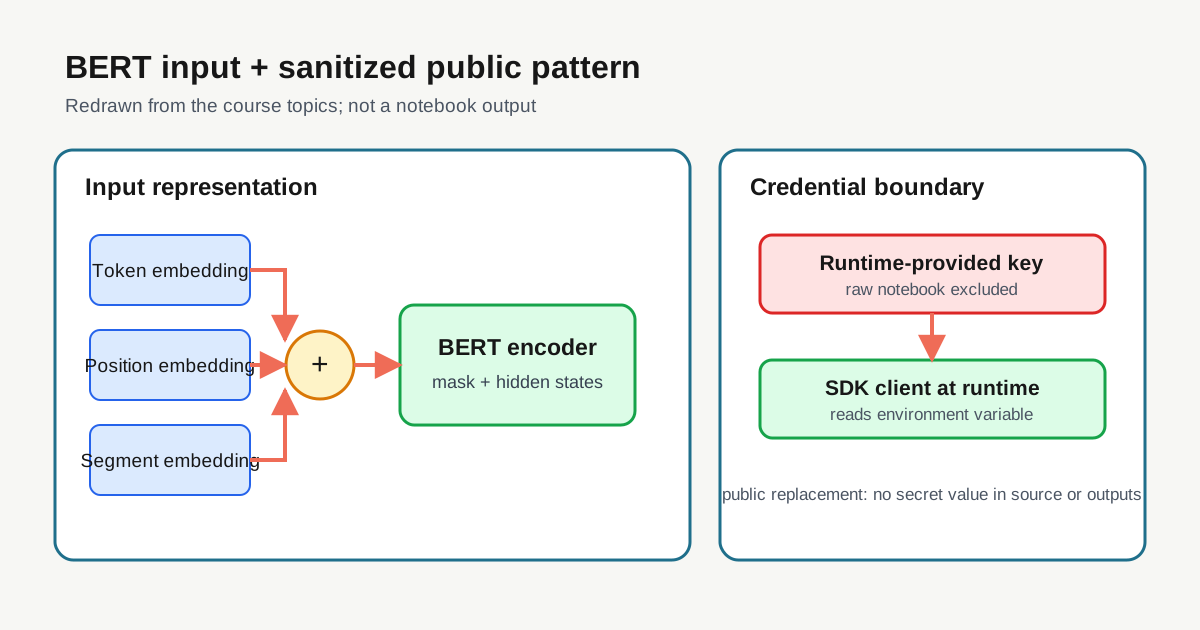
I went beyond the phrase “bidirectional Transformer encoder” and wrote the BERT input as the sum of token, position, and segment embeddings. The 40-page BERT module also helped me locate [CLS], [SEP], and padding in the sequence.
Eᵢ = E(token, i) + E(position, i) + E(segment, i)
Sequence classification uses the [CLS] representation, while token classification uses every timestep. Checking the output shape first prevents connecting the wrong task head.
Attention masks and shapes
Self-attention mixes values according to query-key similarity.
Attention(Q, K, V) = softmax(QKᵀ / √dₖ + M)V
The mask (M) prevents padding positions from contributing. I checked that input_ids.shape == attention_mask.shape, both with (batch, length), and expected classification logits to have (batch, classes).
Hugging Face workflow
I matched the tokenizer and model checkpoint names, passed the tokenizer dictionary directly into the model, and selected the required field such as logits or last_hidden_state from the output object.
encoded = tokenizer(
    texts,
    padding=True,
    truncation=True,
    return_tensors="pt",
)

assert encoded["input_ids"].shape == encoded["attention_mask"].shape
result = model(**encoded)
assert result.logits.shape[0] == len(texts)
Outputs retained in the notebooks
The Hugging Face copy retained 39 cells, 25 code cells, and 125 text or table output objects. Its code source matched the base notebook; the outputs were the difference. The BERT copy had 72 cells and 31 output objects, with 17 of 32 code cells differing from the base. The Gemini copy retained 33 cells, 24 code cells, and 10 output objects.
Sources: archived notebook code, text, and table outputs. Analysis topics: tokenization, masks, tensor shapes, and code flow.
Separating Gemini credentials
The old Gemini notebook contained a plaintext API key. I excluded that raw notebook and rewrote the public example to use an environment variable after the owner revokes and replaces the old key. No value or original credential cell is reproduced here.
import os

api_key = os.environ["GEMINI_API_KEY"]
if not api_key:
    raise RuntimeError("GEMINI_API_KEY is empty")

# Pass api_key to the SDK client without printing or saving it.
Only the environment-variable name remains in source. The value belongs in a shell, Colab secret, or CI secret. Before sharing a notebook, I also check outputs and metadata for accidental credential retention.
Comparing BERT and GPT
The 28-page GPT module uses a causal mask that hides future tokens. BERT reads context on both sides for masked-token learning and downstream representations; GPT-style models predict the next token from left context. The 22-page CV and NLP trends module tied both to the shared workflow of selecting a pretrained backbone, tokenizer, task head, and loss.
Previous and next
Sources used
- BERT — course-pdf; bidirectional attention and fine-tuning
- GPT — course-pdf; causal language modeling
- CV and NLP Research Trends — course-pdf; pretrained-model workflows
- Issuing a Gemini API Key — course-pdf; separating credentials from code