mmWave · FMCW Radar · ECG
Interpretation boundary for radar AO/AC candidates after ECG-anchored beat alignment
2026-07-31 · updated 2026-08-01 · Hyeongrok Ryu
ECG R-peaks, SCG references, FMCW phase morphology, and the distinction between candidate timing and direct valve measurement.
- Type / level
- paper-review · advanced
- Tools
- Python, NumPy, SciPy
Concurrent acquisition system
ECG, SCG, and FMCW radar are acquired over the same interval, with ECG R-peaks serving as common anchors. The radar is a BGT60TR13C, with STM32F411, ESP-32S, and MPU6050 devices in the acquisition and reference paths.
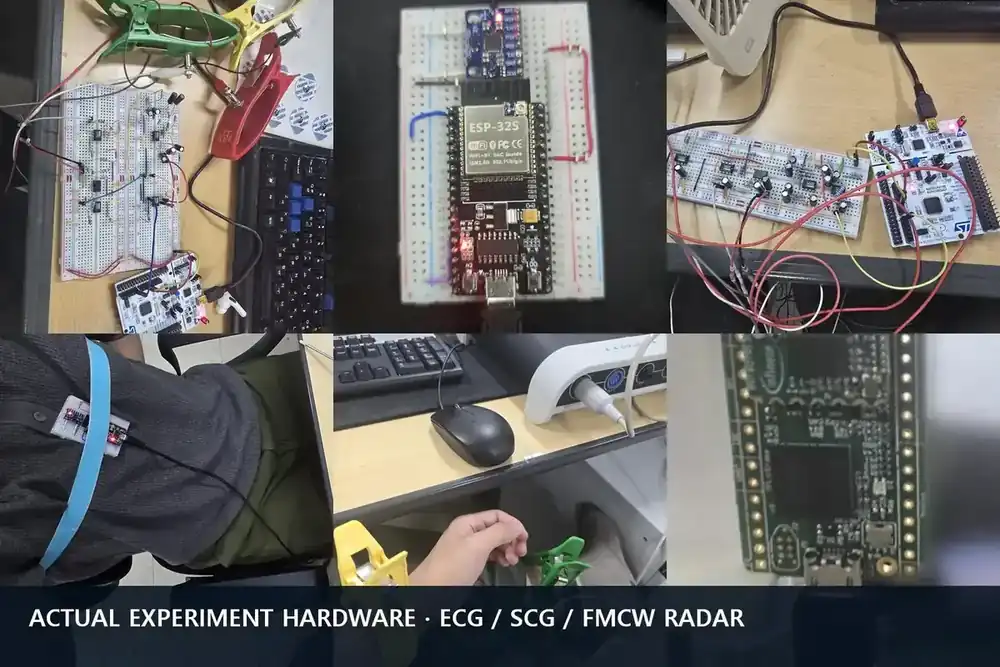
The streams cannot be compared beat by beat until timestamps, sample rates, start offsets, and missing-sample handling are understood.
From radar phase to beats
The processing path calculates a range FFT from FMCW chirps and selects a range bin or ROI containing chest reflections. The phase of the selected complex sample is unwrapped and converted using wavelength-related scaling to obtain a displacement-related waveform.
ROI movement and respiration can alter cardiac morphology. ROI selection, unwrap discontinuities, filtering, and motion rejection are therefore part of the candidate-timing input conditions. One visual peak is not enough to declare a valve event.
ECG R-peak alignment
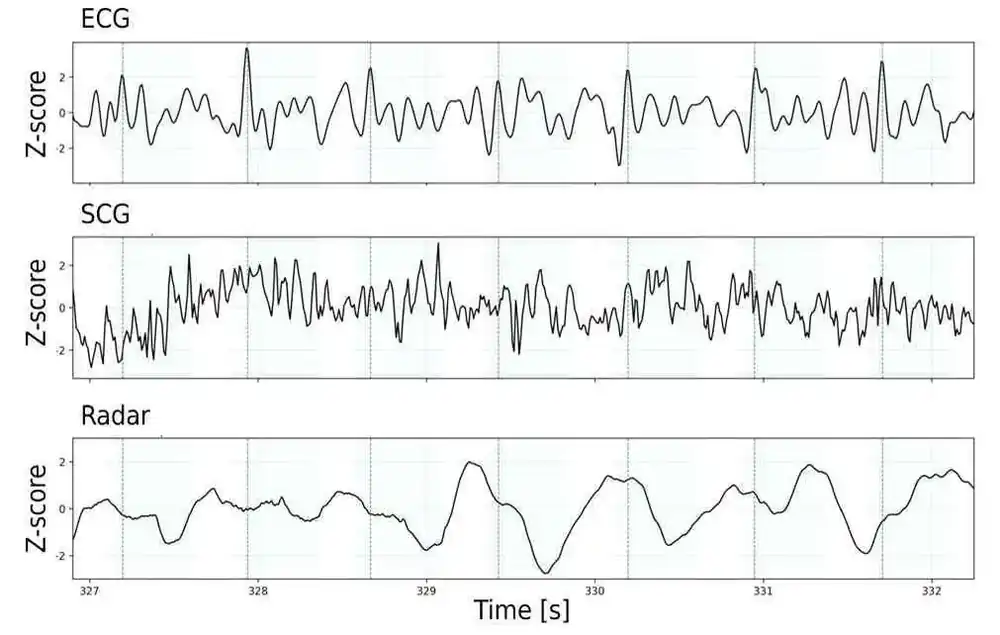
Each R-peak defines a window around one beat. SCG reference timing and radar morphology are compared within that beat. Resampling or length normalization can change timing, so original sample indices and transformed beat coordinates should both be retained.
Paper-reported results: 600 seconds of concurrent acquisition and 848 corresponding beats analyzed.
AO/AC candidate timing
AO/AC-related SCG reference points are constructed, then temporally corresponding radar peaks, slope changes, or detector-fusion outputs are selected. Low-SQI or detector-disagreement beats need separate handling. Candidate Timing Interval summaries describe the selected-point distribution.
AO and AC labels represent morphology-based candidate timing relative to ECG and SCG references. Independent Doppler-echo comparison is a follow-up validation stage.
Supported results and limits
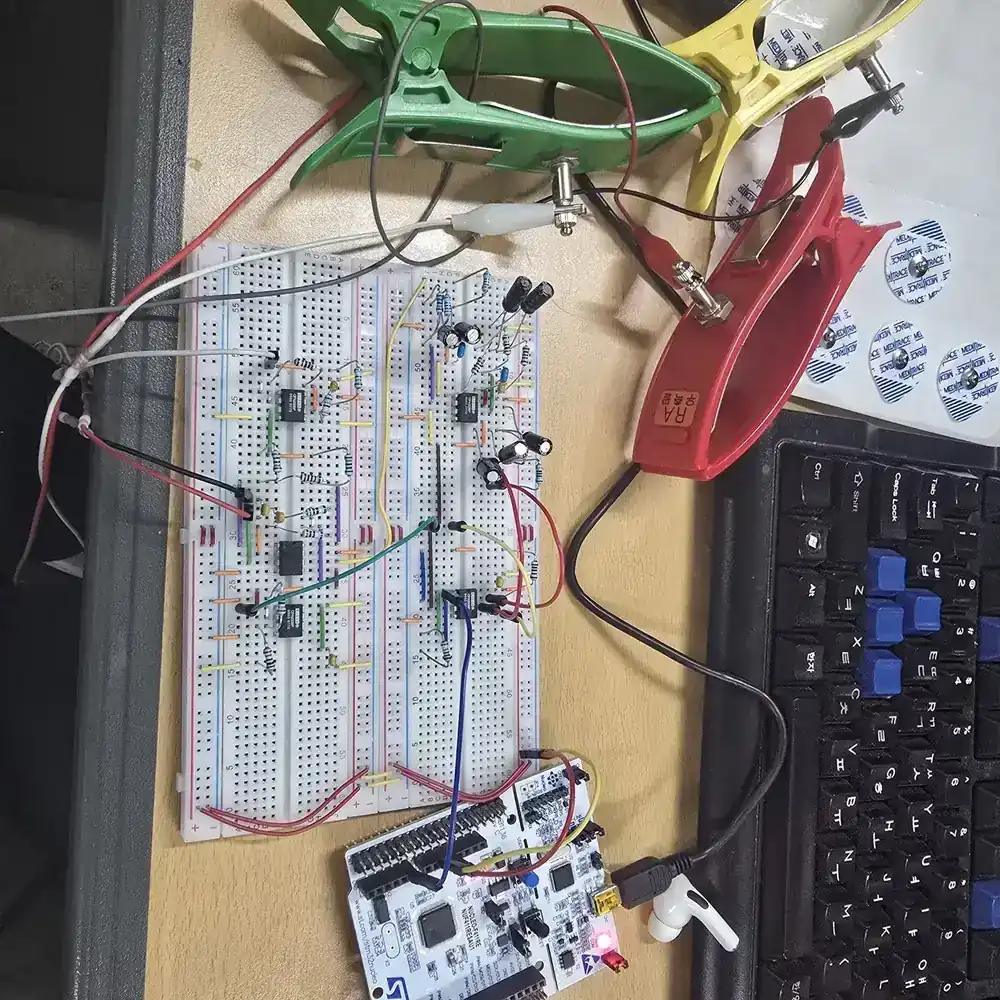
I checked the experiment path against the saved analysis source, firmware, configuration files, and hardware photographs. The paper reports 600 seconds of acquisition and 848 corresponding beats. Clinical sensitivity, specificity, and direct valve detection were not measured in this experiment.
Next validation
Validation closer to an anatomical event requires a synchronized independent reference such as echocardiography, ICG, or PCG. The protocol should quantify clock error, annotation rules, beat exclusion, inter-rater agreement, and timing error or Bland–Altman behavior. Until then, candidate terminology remains necessary.
Sources used
- FMCW Radar AOAC Cardiac Analysis — public-repository; signal flow and candidate timing boundary
- FMCW Radar Cardiac Timing project — portfolio-page; hardware and reported acquisition summary