External Learning & Competitions
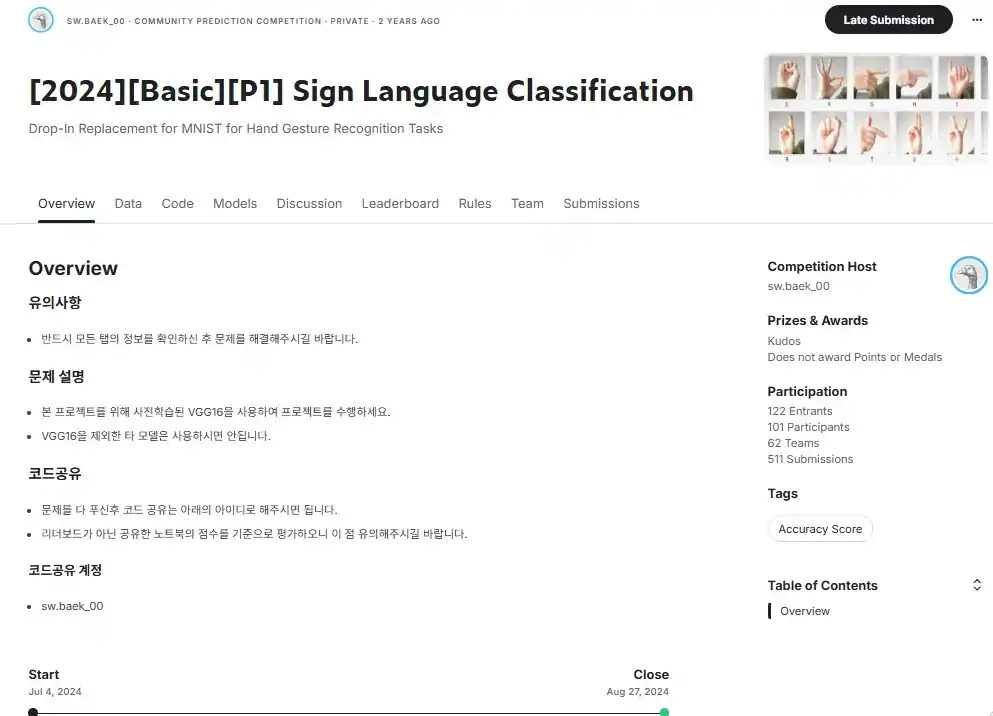
[2024][Basic][P1] Sign Language Classification
I revisited the VGG16 assignment and compared its one-epoch result with a lightweight local baseline.
- Platform
- Kaggle
- Period
- 2024-07-04–2024-08-27
- Host
- sw.baek_00
- Metric
- Accuracy
- Model rule
- Use the pretrained VGG16 model; other models are not allowed
Earlier notebook
The notebook resized 28×28 grayscale images for VGG16 and retained one epoch: train loss 2.5738 and train accuracy 0.2781. I checked channel conversion, resizing, and class balance before extending training.
Lightweight baseline
I used HOG features and an RBF-SVM on an 80/20 stratified random-row split. Accuracy and macro-F1 both reached 1.0.
Why 1.0 is not a generalization claim
The data does not expose signer or source-image groups. Augmented or near-duplicate images may cross the split, so I treat this as a result for this local split rather than performance on unseen signers.
A future comparison will group perceptually similar images and evaluate VGG16 and HOG on the same split. No signed-in Kaggle score or rank was reproduced.
What I changed for the rerun
I compared the original notebook result with a local holdout run. I used HOG(9 orientations, 4×4 cells, 2×2 blocks) + RBF-SVM(C=10) under 80/20 stratified random-row holdout; seed 42.
- Earlier run
- 1 epoch; train loss 2.5738204723; train accuracy 0.2780599031
- Simple baseline
- accuracy 0.0472; balanced accuracy 0.0417; macro-F1 0.0038
- Reworked model
- accuracy 1.0000; balanced accuracy 1.0000; macro-F1 1.0000
The dataset provides no signer or source-group identifier, so leakage by augmented or near-duplicate images cannot be ruled out. The 100% result is local random-row holdout evidence, not generalization or a Kaggle score.
Open the rerun scripts and sanitized notebooks
These numbers come from my documented local split, not from the Kaggle leaderboard. I did not reproduce a signed-in submission history or rank.