Course Study Note
Day 5 — Diffusion, LDM, and Applications
I connected forward noise to reverse denoising, then compared where DDPM, latent diffusion, and Stable Diffusion perform their computation.
- Date
- 2025-07-11
- Course
- 2025 Generative Models Intensive — From VAE to Stable Diffusion
Study checkpoint for this day
Study checkpoint for this day
Study checkpoint for this day
Topics from the day
- DDPM Forward and Reverse Processes
I rewrote timestep-wise noise prediction and the sampling loop.
- Latent Diffusion and Stable Diffusion
I compared why denoising in latent space reduces computation.
- Diffusion Applications and Next Steps
I grouped conditioning
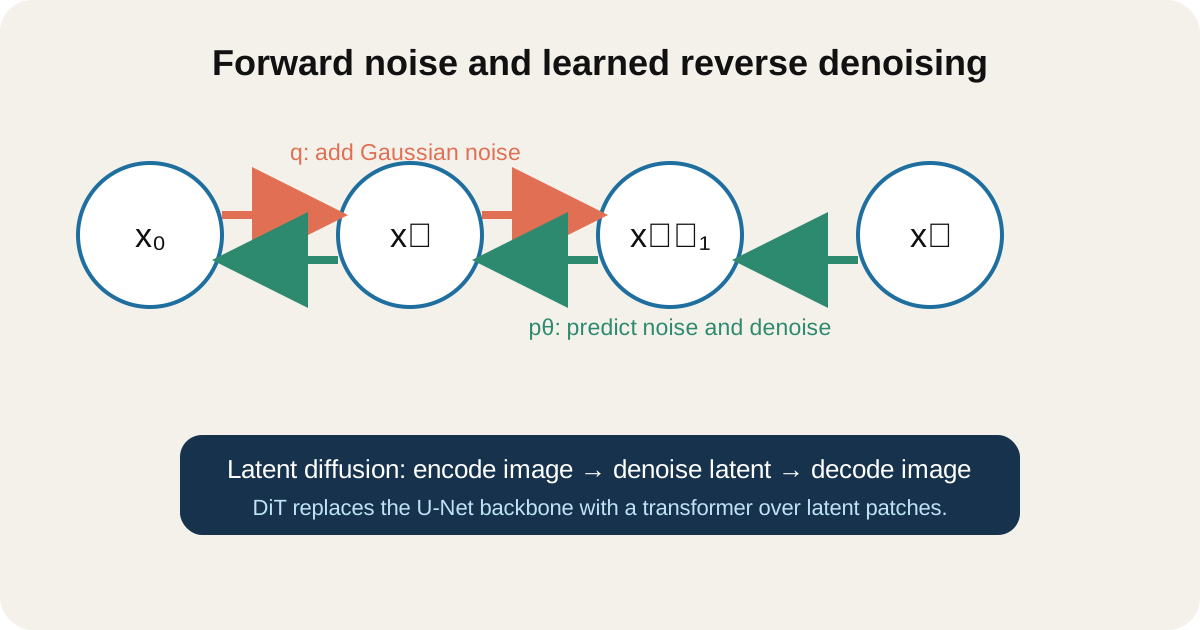
Forward process
Small Gaussian perturbations move (x_0) toward a standard normal sample. A cumulative coefficient produces an arbitrary (x_t) directly during training instead of replaying every earlier step.
Reverse process
In DDPM, a U-Net receives (x_t) and (t) and predicts noise. Training samples one timestep, but generation walks from (T) back to zero and is therefore sequential.
Latent diffusion and DiT
Latent Diffusion performs denoising in an autoencoder’s compressed space and uses cross-attention for conditions such as text. DiT keeps the diffusion objective but replaces the U-Net backbone with a transformer over latent patches.
The course diffusion notebook retained code but no output cells. I will first rerun a small FashionMNIST DDPM and record tensor shapes and the sampling loop before moving to latent diffusion.