Course Study Note
Day 1 — Generative Models and Deep-Learning Foundations
I began with what it means to learn a data distribution, then reviewed tensors and neural-network foundations.
- Date
- 2025-07-07
- Course
- 2025 Generative Models Intensive — From VAE to Stable Diffusion
Study checkpoint for this day
Study checkpoint for this day
Study checkpoint for this day
Topics from the day
- Generative Model Overview
I compared generation with discrimination and connected likelihood to sampling.
- Deep-Learning Foundations
I revisited tensor shapes
- Dataset Visualization
I practiced inspecting distributions and outliers before choosing a model.
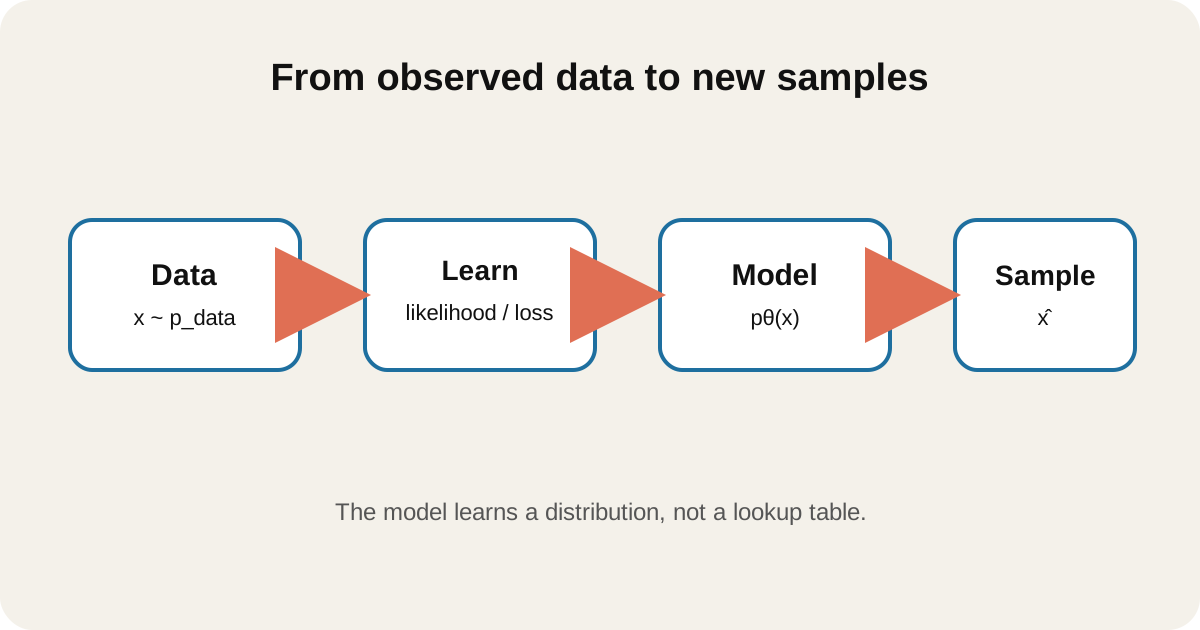
Generation versus discrimination
| A classifier focuses on a conditional such as (p(y | x)). A generative model works with (p(x)) or a joint distribution and samples a new (x). This view made the differences among autoregressive models, VAEs, GANs, and diffusion easier to compare. |
Tensor shapes first
I printed batch, channel, height, and width before constructing the network. A loss can still return a number when normalization or flattening uses the wrong axis, so shape checks came before tuning.
Looking at the data
I inspected class balance, ranges, missing values, and duplicates before choosing a model. Preprocessing statistics belong to the training split; calculating them before the split leaks information.
Next question
The next step was to ask whether a difficult joint distribution could be rewritten as a sequence of conditional probabilities.