AI · Deep Learning · Computer Vision · Generative AI
From DDPM to Latent Diffusion and DiT
2026-08-01 · updated 2026-08-01 · Hyeongrok Ryu
Notes connecting forward noise, reverse denoising, latent space, and a transformer backbone.
- Type / level
- study-note · advanced
- Tools
- Python, PyTorch
Forward process
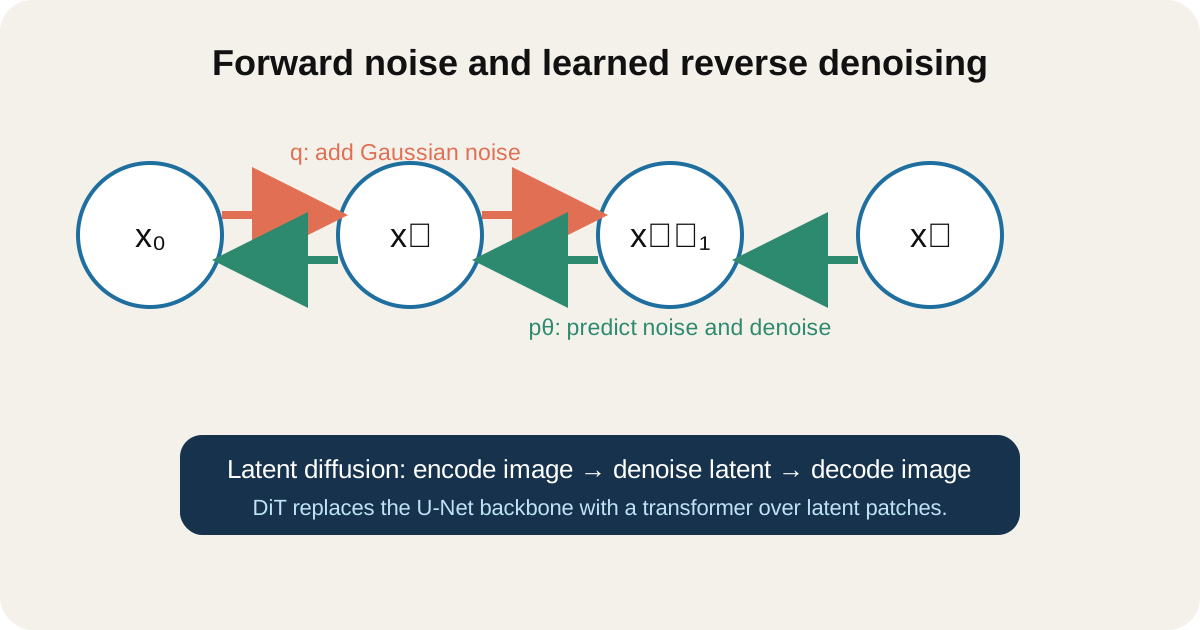
Repeated Gaussian perturbations move clean (x_0) toward a simple (x_T) distribution.
Reverse process
Generation starts from noise and moves from (T) toward zero. The model predicts a distribution parameter or the added noise at each step.
Noise prediction
Training samples a timestep and constructs (x_t) directly with cumulative coefficients. Sampling remains sequential over all timesteps.
Latent diffusion and DiT
Latent diffusion denoises inside an autoencoder representation and decodes the image afterward. DiT replaces the U-Net noise predictor with a transformer over latent patches.
Rerun order
The course notebook retained code but no outputs. I will first check tensor shapes and the sampling loop on FashionMNIST, then add the latent encoder and decoder boundary.
Sources used
- Denoising Diffusion Probabilistic Models — paper; DDPM objective
- High-Resolution Image Synthesis with Latent Diffusion Models — paper; latent diffusion
- Scalable Diffusion Models with Transformers — paper; DiT